- Digital Display Insider
- Posts
- Issue #40: The Two Sentences That Cost New Mobile Digital Billboard Operators the Most...
Issue #40: The Two Sentences That Cost New Mobile Digital Billboard Operators the Most...
Why they sound confident... but quietly cost new Mobile Digital Billboard operators years—and sometimes millions—in missed revenue.

Jerry Teeter
January 15, 2026 • Estimated Reading Time: 8 minutes
Editors Note

The Two Most Expensive Sentences in This Industry.
“I’ve done my research” and “I’ll figure it out.”
Most first-time Mobile Digital Billboard operators say those with total confidence—and I don’t blame them. You can watch a few videos, skim a few websites, learn a couple buzzwords, and feel like you’ve got a handle on what you’re doing. But this industry has an iceberg nobody sees coming: the truck is the easy part… the system underneath it is what determines whether you get traction or get stuck.
In this issue, I’m breaking down why those two sentences sound smart, but quietly cost new operators years—and sometimes millions—in missed revenue. Because “figuring it out” isn’t free. It’s just a hidden bill you pay later through underpricing, churn, chaos, and delay.
Let’s get into it.


M.D.B. Startup Focus
I’ve heard the same sentence more times than I can count:
“Jerry… $40k is just too much money” or my favorite is “I’ve done my research.”
And I get it.
When you’re shopping for a truck, thinking about leaving your job, trying to make a smart move for your family, forty thousand dollars feels like a lot. Especially when you’re already staring down a multiple six-figure truck purchase, insurance, startup costs, and the mental weight of starting something new.
But here’s what most people don’t realize in that moment:
They’re not actually evaluating the cost of the Total360 operating system.
They’re evaluating it against a plan in their head that sounds like this:
“I’ll just figure it out.”
And that’s where the real problem starts.
Because “I’ll figure it out” sounds free… but it’s one of the most expensive sentences you can say in business.
“I’ll figure it out” sounds free… but it’s one of the most expensive sentences you can say in business.
Not expensive in theory. Expensive in real dollars, real time, real stress, and real missed revenue.
The reason I know that is because I’ve lived both sides of it—first as an operator trying to invent the whole thing, and now as someone who has watched hundreds of operators repeat the same painful learning curve… because they didn’t know what they didn’t know.
So in this issue, I want to do something different.
I want to show you the invisible part of this business.
The part you can’t see in the truck brochure.
The part you won’t learn from watching a couple YouTube videos.
The part that determines whether this becomes a stable business… or a very expensive hobby.
The Two Operators Story (same truck, different outcomes)
Let me introduce you to two fictional operators. I’m making them up, but if you’ve been in this industry for more than five minutes you’ve met both of them.
Operator #1: The Inventor
He buys a truck.
He’s excited. Motivated. All-in.
He has the same plan most people start with:
“I’ll get a website up, post on social media, call some businesses, and I’ll sell a few packages.”
He’s not lazy. He’s not dumb. He’s just new.
So he starts building things.
A logo. A website. A few “packages.” A pitch. A route.
But within 30 days, he starts running into reality.
People ask questions he can’t answer confidently.
“How many times will my ad show?”
“What area are you covering?”
“What happens if it rains?”
“Can I switch creatives?”
“How do I know you ran it?”
“What’s the difference between this and a billboard?”
“Why are you more expensive than the other guy?”
So he adjusts.
He changes pricing. He changes packages. He changes the route. He rewrites the pitch. He makes a new flyer. He tries to sell a different type of customer. He takes a few random exclusive jobs “just to get money coming in.”
He stays busy… but nothing stacks.
And the whole time, he’s telling himself:
“This is normal. I’m learning. I’ll figure it out.”
Then year one hits.
He has some revenue, but it’s inconsistent. The jobs are scattered. The effort is high. The cash flow is unpredictable. And worst of all, he can’t really explain what his business is in one sentence—because even he isn’t sure yet.
That’s when the thought starts creeping in:
“Maybe this business doesn’t work.”
And within 12-18 months… many operators are already thinking about getting out.
Not because the truck doesn’t work.
Because their system doesn’t work.
And they didn’t realize they were responsible for inventing one.
Operator #2: The Builder
This operator buys a truck too.
But instead of inventing, he starts with a proven system.
He doesn’t wake up trying to “think” his way through the business. He wakes up and executes.
His route isn’t a guess.
His pricing isn’t emotional.
His packages weren’t created on a napkin.
His fulfillment isn’t winging it.
His sales process is structured.
His renewals aren’t a surprise every month.
He can start selling with confidence because he knows what he’s selling—and more importantly, he knows how it gets delivered.
Which means while Operator #1 is still “figuring it out”… Operator #2 is stacking MRR (Monthly Recurring Revenue).
Same industry. Same type of truck.
Completely different outcomes.
And the only difference is whether they built a business on invention… or on a blueprint.
The Iceberg: What people see vs. what actually makes this work

Most first-time buyers think they’re buying an LED truck and selling advertising.
That’s the part above the waterline.
But what you’re actually building is something much bigger:
A media company.
A local route operation.
A sales machine.
A fulfillment system.
A retention engine.
A cash flow strategy.
And all of those pieces must work together, or you end up with chaos.
This is why I like the iceberg visual so much.
Because the visible part of this business is small:
Buy a truck
Get a few advertisers
Run the route
But under the surface is where success is won or lost.
The offer has to be designed correctly.
The route has to be designed correctly.
The fulfillment has to be consistent.
The reporting has to match expectations.
The contracts have to protect you.
The pricing has to support the model.
The sales process has to be repeatable.
And the biggest problem for most new operators is simple:
They don’t even realize these decisions exist until they’ve already made the wrong ones.
The “$40k is too much” lie — and what it’s really costing you
Here’s the hard truth:
Most people aren’t comparing Total360 to another system.
They’re comparing it to their imagination.
They’re assuming that “figuring it out” is cheap because they aren’t writing a check for it.
But you pay for it anyway.
You pay for it in:
years of delay before you have stable recurring revenue
underpricing early contracts that lock you into bad margins
churn because you promised outcomes you couldn’t consistently deliver
random one-off jobs that keep you busy but don’t build a base
missed opportunities because you weren’t positioned confidently
stress and overwhelm because nothing feels predictable
And there’s also the biggest cost of all:
the revenue you could have earned sooner if you had started with a real system.
Let’s use simple example math.
If a proven system helps you reach $20-30k/month in recurring revenue even 6 months sooner than you would on your own, that’s $120k-180k in revenue you didn’t have to wait for.
And that doesn’t even include what you save by pricing correctly, reducing churn, improving close rates, and avoiding the “anything I can get” trap.
So when someone says, “$40k is too much,” what they’re really saying is:
“I can’t see what I’m buying.”
And that’s on me to communicate better.
Because you’re not buying videos.
You’re not buying documents.
You’re buying compressed time and proven integration.
“Because you’re not buying videos.
You’re not buying documents.
You’re buying compressed time and proven integration.”
You’re buying the part most operators spend years trying to cobble together.
Why “making it up as you go” fails in this business
In some industries, you can wing it for a while.
If you’re mowing lawns or power washing driveways, you can start simple and refine as you grow. You’ll still make money. The learning curve is survivable.
This business is different.
Because the moving parts aren’t independent.
They’re connected.
If you change pricing without changing capacity rules, you create churn.
If you sell whatever the client wants without defined deliverables, you create fulfillment chaos.
If your route boundaries aren’t deliberate, you can’t articulate value.
If you don’t have a tight process for proof of performance, clients doubt you.
If you don’t have a renewal structure, every month becomes a resell.
If you don’t have a real sales system, your pipeline becomes inconsistent.
What looks like “flexibility” in the beginning becomes instability by month six.
And most people don’t realize the damage until they’ve already trained the market to treat them like a commodity.
What you’re actually buying when you buy a franchise-level system
When someone buys the Total360 system, the biggest thing they get isn’t the content.
It’s the integration.
It’s the fact that the hundreds of decisions under the iceberg have already been figured out and were engineered to work together.
High level, that includes things like:
an offer structure that isn’t confusing
pricing logic that supports recurring revenue
route principles that can be duplicated
fulfillment standards that retain clients
sales messaging that sells outcomes, not screen time
systems that keep you consistent even when you’re tired
It’s the difference between being an operator who constantly wonders what to do next… and being an operator who knows exactly what to execute.
And that’s why the real value isn’t “education.”
It’s speed. It’s confidence. It’s avoiding expensive trial-and-error.
The blueprint analogy (and why intuition doesn’t count)
Here’s the part that trips up first-time buyers:
Most people build their plan based on intuition, basic research, and conversations with the guy trying to sell them a truck.
They don’t have a blueprint made by someone who has already done it.
So what do they do?
They try to create the blueprint themselves… with zero experience.
That’s like saying:
“I’ve lived in a house my whole life, so I can probably build one.”
You might be able to build something.
But it probably won’t be efficient.
It probably won’t be scalable.
And it will definitely cost you more than you expected.
Wise builders start with a blueprint.
And that’s exactly what Total360 is.
The real question isn’t “Is it too much?”
The real question is:
“How much is it going to cost you to not have it?”
How many years will you spend tinkering?
How many contracts will you underprice?
How much churn will you create before you tighten your fulfillment?
How many times will you rebuild your website, your pitch, your packages?
How many thousands will you spend learning lessons you could have avoided?
Because here’s what I know for sure:
Every operator pays tuition in this business.
The only question is whether you pay it with:
time, mistakes, and missed revenue…
ora system that collapses years into weeks.
Final thought
If you’re reading this and thinking, “I can just figure it out,” you might be right.
But don’t confuse “possible” with “smart.”
The market is getting more competitive. The buyers are getting more educated. And the operators who win the next decade of this industry won’t be the ones with the cheapest truck or the cheapest pricing.
They’ll be the ones with the cleanest system that the value can easily be articluated to the customer.
Because the system is what creates MRR.
MRR is what creates stability.
Stability is what creates scale.
And scale is what creates freedom.
Ready to take the next step?
If you’re serious about starting an MDB (Mobile Digital Billboard) business—and you don’t want to spend the next 12 months paying “tuition” through trial and error—come spend a day with us at Discovery Day on February 27th.
You’ll get the information you can’t find on Google or AI, you’ll see the business and system in real life, and you’ll get hands-on time with a brand new Legion 714 so you can decide—clearly—whether this business is for you.
Details and tickets are here: www.ledtrucks.com/discoveryday
Keep it simple, keep it profitable, and build the legacy while you build the business.

Industry Discovery Day
Legion LED Trucks is the FIRST and ONLY option to learn detailed information about the mobile digital billboard industry BEFORE buying a truck.
For people who are on the fence about whether they should invest into this business, this is a way to figure that out for a few hundred dollars before spending $200k+. The information taught can not be found on Google or through Ai and the LED truck demo is your chance to be up close and personal with a brand new LED truck from Legion LED Trucks.
These events are small with limited seating. Only 2 VIP tickets available! Reserve your seat now before they are gone.

LED Truck Financing Options
Financing Your LED Truck With Ascentium Capital
Legion LED Trucks has partnered with Ascentium Capital to offer flexible financing and options for both new and used LED trucks! Whether you’re looking to start or grow your MDB business, these financing plans provide an affordable way to get on the road with minimal upfront investment.
Ascentium’s flexible structures combined with 100% financing means you avoid substantial out of pocket costs. Apply without financials up to $400k. Most credit decisions within 1-2 hours.

Sponsored Content

A big 2026 starts now. True builders use this stretch of time to get ahead, not slow down. Launch your website with AI, publish a stunning newsletter, and start earning more money quickly through the beehiiv Ad Network. Use code BIG30 for 30 percent off your first three months. Start building for 30% off today.
Bonus Content
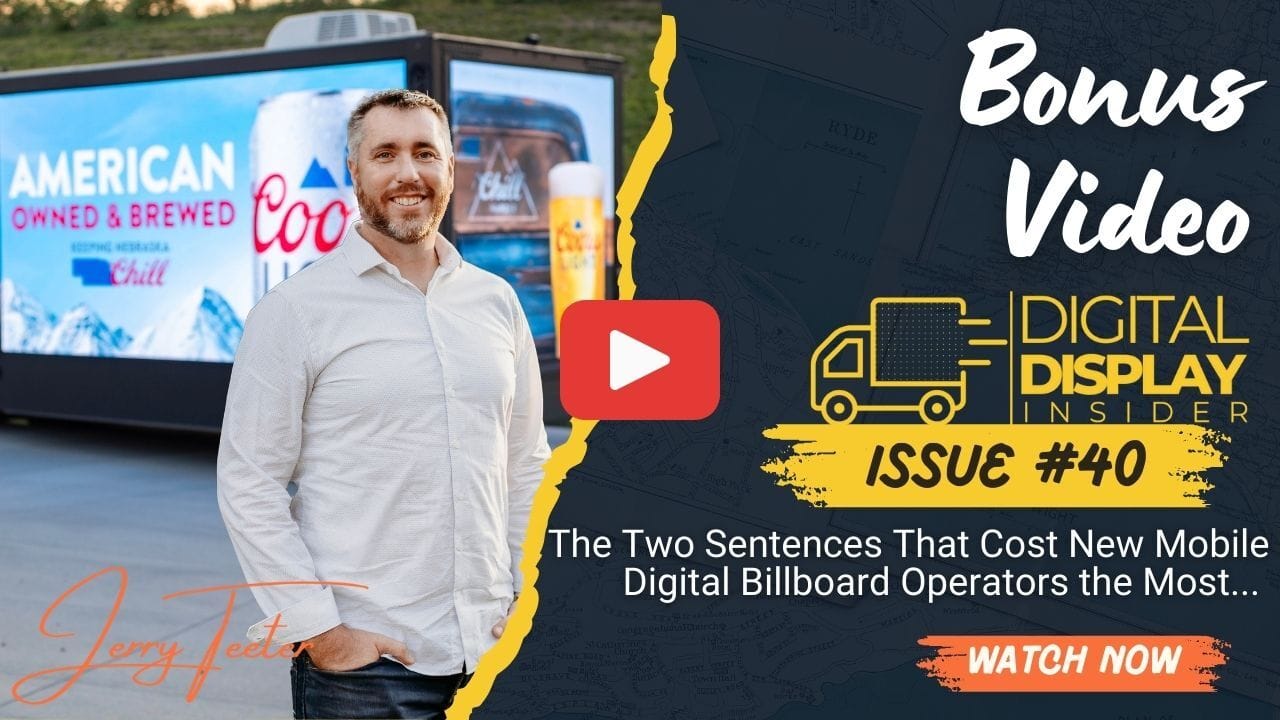
Want to hear me talking more in depth about todays topic? Click below to watch the bonus video on Youtube.
Equipment For Sale

