- Digital Display Insider
- Posts
- Issue # 41: How to Start a Mobile Digital Billboard Business
Issue # 41: How to Start a Mobile Digital Billboard Business
The Four Cornerstones of Success—and why inventing your own system is the most expensive way to “start.”

Jerry Teeter
January 28, 2026 • Estimated Reading Time: 6 minutes
In partnership with

Editors Note

“How do I start a Mobile Digital Billboard business?” is one of the most searched questions in this industry—and it’s also the question I hear from people who are confident they’ve “done their research,” but still don’t really know what matters most.
Because the truth is, this business isn’t won by buying a truck and hoping it works out. It’s won by building the right foundation in the right order. In this issue, I’m going to walk you through the Four Cornerstones of Success—Truck, Model, System, and Salesperson—with a heavy emphasis on the one most first-time operators underestimate: The System. The difference between inventing your own system and starting with a proven one isn’t a small detail… it’s the difference between momentum and chaos.
Let’s get into it.


M.D.B. Startup Focus
“How do I start a mobile digital billboard business?”
It’s one of the most searched questions in this industry, and it’s the question I get the most from people who are serious enough to be shopping trucks but still early enough to think this is mostly about buying equipment.
Here’s the truth: starting an MDB (Mobile Digital Billboard) business isn’t complicated… but it is layered.
And most people don’t fail because they didn’t work hard. They fail because they built the business in the wrong order, with the wrong assumptions, and with no blueprint for how all the moving parts are supposed to work together.
They buy a truck first.
Then they “do some research.”
Then they start creating random packages, running random routes, taking random jobs, and trying to make it all work in real time.
It feels productive… until you realize you’re building the airplane while trying to take off.
So in this issue, I want to give you a real answer. Not motivational fluff. Not generic “start an LLC and post on social media.” I’m going to lay out the framework I use to evaluate every operator’s odds of success.
It’s the Four Cornerstones of Success:
The Truck
The Model
The System
The Salesperson
If any one of these is missing, the business becomes fragile. And the cornerstone most new operators underestimate—by a mile—is The System.
Because without a system, you don’t have a business.
You have a truck and a bunch of activity.
The biggest myth: “I’ve done my research.”
When someone tells me they’ve “done their research,” I usually hear one of two things:
They researched trucks (mostly marketing claims).
Or they researched the industry (mostly surface-level info).
What they almost never researched is the hardest part: what it actually takes to operate and scale this business in the real world.
Because you can’t Google your way into a proven operating blueprint.
And the market won’t give you a pass while you experiment.
Your first clients will judge you based on whether you look legit, whether you deliver cleanly, and whether you communicate like a real media company—not a guy with a screen.
That’s why the order matters.
Let’s walk through the Four Cornerstones the right way.
Cornerstone #1: The Truck
You’re not buying a vehicle. You’re buying reliability, credibility, and uptime.
A Mobile Digital Billboard truck is the platform that delivers the service. If the platform fails, everything fails—revenue, reputation, renewals, referrals, resale value.
Most first-time buyers don’t know what to look for, so they default to what’s easy to understand:
“How big is the screen?”
“What’s the pixel pitch?”
“How much does the LED truck cost?”
Those are not useless questions. But they’re not the questions that determine whether you’ll still be operating two years from now.
The truck you choose should be evaluated like an income-producing asset, not a toy:
Can it run daily routes without constant breakdowns?
Does it look professional enough that a serious business will pay you recurring money?
Can you service it quickly without waiting weeks for mystery parts?
Does it have the right control system and A/V setup to handle real-world jobs?
Do you have spare parts, especially spare LED modules, so the screen stays marketable as it ages?
A good truck doesn’t just make your life easier.
It protects your business from random, expensive surprises. And in this industry, surprises are what crush cash flow.
Cornerstone #2: The Model
Most new operators unknowingly choose a model based on whatever job shows up first.
That’s backwards.
The Model is the business concept you’re committing to. In simple terms, most operators live in one of two worlds:
Exclusive Use: The truck is dedicated to one client for a set amount of time.
Shared: Multiple advertisers share the truck over a recurring period, typically built around a defined route or zone.
Both can make money.
But they behave very differently.
Exclusive Use tends to feel easier at first because it’s straightforward: time for money. But it can become volatile fast—feast or famine, inconsistent scheduling, inconsistent cash flow, and too many operators end up discounting just to keep the truck moving.
Shared is harder to set up because you must define a repeatable offer and deliver it consistently. But when it’s done right, it creates stability and predictability.
This is where you need to decide what you actually want:
Do you want to constantly chase the next job… or do you want to build recurring revenue?
Because the Model you pick changes everything downstream—pricing, routing, contracts, fulfillment, staffing, and how you sell.
Cornerstone #3: The System
This is the cornerstone nobody respects until they’ve paid “tuition” for ignoring it.
The System is how you execute your Model—consistently, predictably, and in a way that can scale.
And here’s where most people make the most expensive mistake in the industry:
They try to invent the system while selling it.
They think the system is something you “improve over time.”
That sounds reasonable… until you realize the “improvement” process is paid for with:
underpriced contracts you can’t fix for 90 days
poor fulfillment that creates churn
inconsistent messaging that confuses the market
random one-off jobs that keep you busy but don’t build momentum
stress from constantly changing what you’re doing
The system is not a logo. It’s not a website. It’s not “posting content.”
The system is the machine.
A real system answers questions like:
Offer Design
What exactly are you selling?
What’s included and not included?
What are the rules of the offer (capacity, timing, creative changes, cancellations)?
How do you package value so you’re not selling “screen time” like a commodity?
Route and Delivery
What zone are you committing to?
How many hours per week are you running it?
What proof do you provide?
What are your quality standards so the service looks premium every day?
Fulfillment
How do you intake creative?
Who approves it and how fast?
What happens when something goes wrong?
How do you communicate with clients so they feel taken care of?
Renewals and Continuity
If you don’t have continuity in your business, you don’t have a business—you have a promotion.
Continuity is simple: recurring revenue that comes in month after month because you’ve designed the offer to retain customers.
Without that, you’re constantly restarting your month from zero.
Scaling
A real system isn’t just designed to “work once.” It’s designed to be duplicated. That’s the difference between owning a truck and owning a company.
Inventing vs. using a proven system
This is where Total360 matters, and why I talk about it the way I do.
Total360 isn’t “information.” It’s an operating framework that collapses years of trial-and-error into a structured playbook—offer design, route structure, fulfillment standards, sales process, and how it all fits together.
When you use a proven system, you can start selling with confidence because you already know what you’re delivering.
When you invent it, you’re guessing in public, and your first customers become your test market.
That’s an expensive way to learn.
Cornerstone #4: The Salesperson
A great system doesn’t sell itself.
This is where a lot of operators get humbled.
They assume: “The truck is cool, so businesses will buy.”
But you’re not selling a truck.
You’re selling an outcome.
More customers. More foot traffic. More awareness. More legitimacy. More attention in the places that matter.
If you can’t clearly communicate what your service does for the customer—without drowning them in technical talk—you’ll struggle.
And in the early days, you don’t need to be a charismatic closer.
You need to be consistent, confident, and focused on the right prospects.
The best operators aren’t the ones who talk the most.
They’re the ones who can diagnose what the customer actually wants and connect it to a simple offer that makes sense.
So how do you start—practically?
If you want the cleanest path, here’s the order I recommend:
Decide your Model (don’t let random jobs decide it for you)
Choose a Truck that supports the Model (reliability, uptime, spares, control system, serviceability)
Implement a System (offer, route structure, fulfillment, renewals, proof, contracts)
Develop the Salesperson (outcome-based communication, pipeline discipline, follow-up consistency)
That’s it.
Not easy. But simple.
And if you do it in that order, you drastically reduce the risk of becoming another operator who works hard for 12 months and then starts thinking about getting out—because nothing worked the way they thought it would.
Final thought
You can absolutely start this business by inventing the system from scratch.
Plenty of people try.
But don’t confuse “possible” with “smart.”
A proven system doesn’t just save time. It protects you from expensive mistakes and delayed profitability—two things that quietly kill more Mobile Digital Billboard businesses than anything else.
Keep it simple, keep it profitable, and build the legacy while you build the business.
Industry Discovery Day
Legion LED Trucks is the FIRST and ONLY option to learn detailed information about the mobile digital billboard industry BEFORE buying a truck.
For people who are on the fence about whether they should invest into this business, this is a way to figure that out for a few hundred dollars before spending $200k+. The information taught can not be found on Google or through Ai and the LED truck demo is your chance to be up close and personal with a brand new LED truck from Legion LED Trucks.
These events are small with limited seating. Only 2 VIP tickets available! Reserve your seat now before they are gone.

LED Truck Financing Options
Financing Your LED Truck With Ascentium Capital
Legion LED Trucks has partnered with Ascentium Capital to offer flexible financing and options for both new and used LED trucks! Whether you’re looking to start or grow your MDB business, these financing plans provide an affordable way to get on the road with minimal upfront investment.
Ascentium’s flexible structures combined with 100% financing means you avoid substantial out of pocket costs. Apply without financials up to $400k. Most credit decisions within 1-2 hours.

Bonus Content

Equipment For Sale
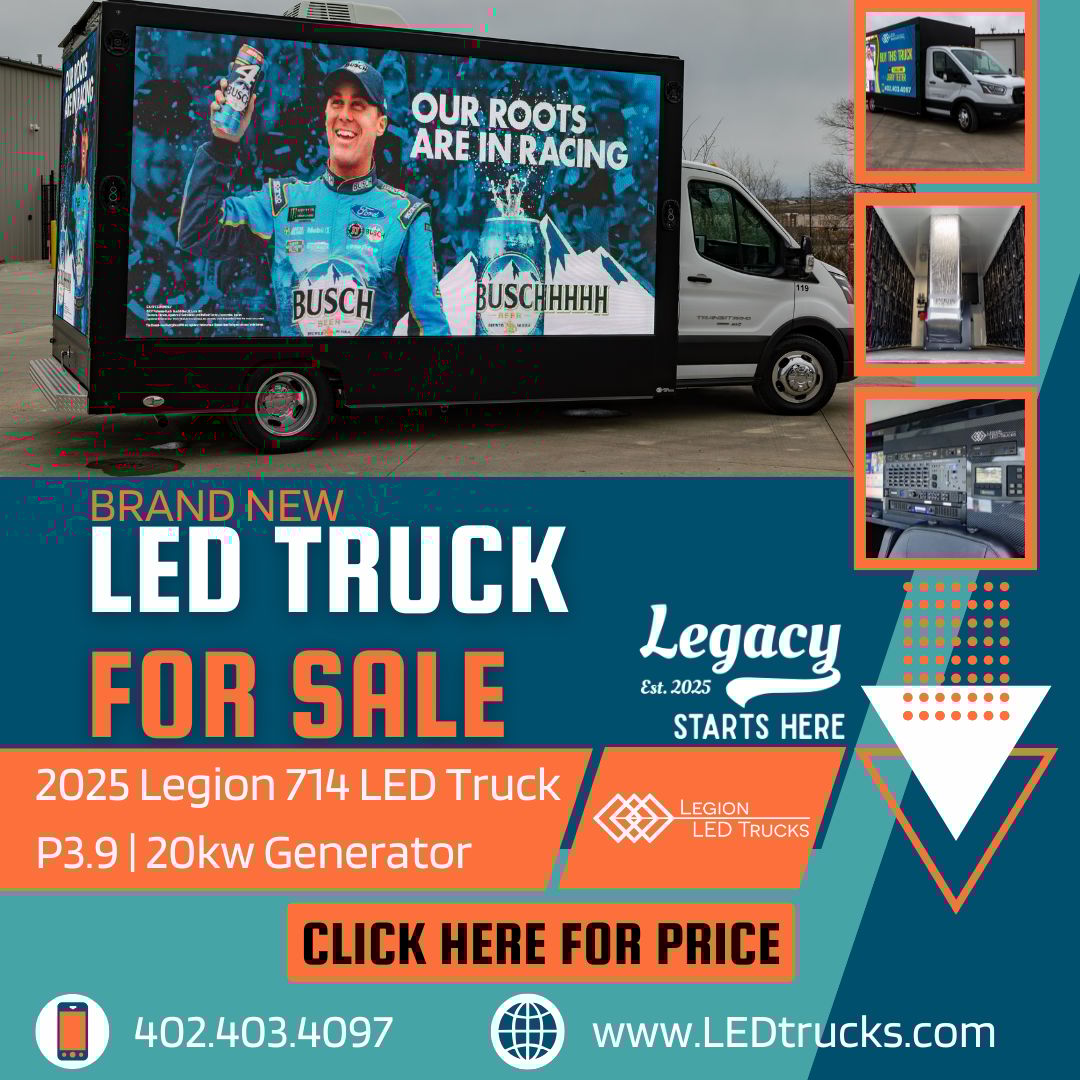
Brand New Legion 714 P3.9 For Sale
Sponsored Content:
Want to get the most out of ChatGPT?

ChatGPT is a superpower if you know how to use it correctly.
Discover how HubSpot's guide to AI can elevate both your productivity and creativity to get more things done.
Learn to automate tasks, enhance decision-making, and foster innovation with the power of AI.
